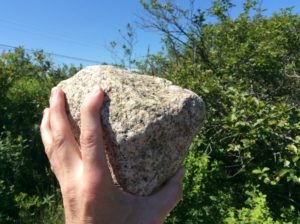
A Stone’s Throw

Stone in hand

Oblivious to its weight

Oblivious to its origin

Highly-motivated aim

Thoughtless trajectory

Silent with an uncertain shadow

Impact, all revealing ,       Undeniably shattered ,        Regret tangled in debris.

B. Toner  July 2017


A Stone’s Throw

Regret is a heavy burden and not necessarily a great teacher. It hides from the decision process and only reveals itself upon impact. I need to admit that many of my actions are emotionally charged and therefore regrettable.

People in glass houses right? Let the one who has no sin throw the first stone!  Great advice! If I took time to examine that Stone before I tossed it…….

Is it well polished from the long time I’ve carried it in my pocket? Does fresh soil still cling to it? Did I leave a hole from where I dug it ?

Sometimes I throw myself completely into it, using both hands. At other times the pebble is so small I can toss it without effort, usually without care.

I can throw it far and easily ignore the results. Walk away without watching it fly. I can stand too close and eagerly watch it shatter the target.

There is always wreckage.

Too often, I neglect to roll the Stone in my hand.  With thought, weigh its consequences. With practice, calculate the distance to the result. With effort, maybe measure the impact. With intent, control myself and turn my action into inaction. With compassion,  avoid the destruction.

I can learn to put down the Stone..

Porous walls

POROUS WALLS

In the housing business, the construction of a wall is paramount to the success of the building. I’ve heard that houses need to breathe. The goal, however, is a tight seal. Walls that let harmful substances leak through are damaging to its durability. Weak walls result in weak houses.

Public schools can also be tightly sealed in their control of programs. They try to protect the learning that takes place inside with a strong roof and thick walls. More often though, numerous outside parties now influence the academics of the students. Some positively, some negatively. Although still rigid, our classroom walls have become more porous. I’m at ease with that image; a strong structure with small spaces for drafts of new ideas.

What about humans? People like me work very hard to build walls. I keep out what I detest or what I fear. With highly developed talents, I live within my well-defined space. I’ve constructed a solid belief that I can control what and how things affect me.

It takes an incredible force to break down a human wall, my walls. When it happens, it’s explosive! Damaged walls remove your sense of security. It’s almost impossible to rebuild when you can’t recognize the old, protective framework. Trying to force down another’s defenses usually results in irreparable destruction; a broken spirit.

Contrary to house walls , I think I need to make my walls more porous, – to let things seep through gradually, –  to avoid patching every hole perfectly. Experiences that drip through, may mark up the furniture, may taint the colour of the room, but they only change the atmosphere in small ways. They make me only a little uncomfortable. They don’t destroy the support beams. It’s much easier to adjust to a small fissure than to recover from a wrecking ball.

In turn, to influence another, I must finds ways through the cracks in the bricks or to gently chip away at the armoured space. Take my time to explore for tiny openings where ideas can squeeze through. Trying to knock it over with force will only leave someone with a pile of rubble and no safe place.

If I begin with the premise that our walls are porous, I can make a place for the thoughts of others and maybe leave my mark within their shelter.

The next time I feel a draft, I’ll try to recognize it as the easier alternative for change.

Porous Walls

It’s bone-crushing work! Taking a sledge hammer to your wall or an anchor brace for mine. I’m blocked by bricks neatly stacked in place or wrecked into piles. I’m either damaged from a head-on collision or lying in rubble. The sturdier I try to make it, the harder it is to keep standing. Pressed up against it, I can feel it shake. That’s when I need to steady myself and look for cracks. Discover peep holes and take in the widest view possible. Feel for a draft and suck in that supply of air. That tiny view, that small breath can save my wall. Can save me.

B. Toner – April 2017

Loose ends

Like most people, I enjoy closure. Please, I want no stray glasses when I’m finished doing the dishes. I place the cap snuggly on the pen. I say definitive goodbyes. I complete the last chapter of most books before picking up the next one. I invest emotionally in a movie and expect the cliffhanger resolved before the credits roll. When the game is over, there is a winner and a loser.

On the other hand, I can learn from loose ends.

I can dream in anticipation of when I meet her again and plan what to say to impress. I can tell myself that I will finish writing that book and believe it! I can refrain from responding to a friend’s unwelcomed comment and instead discern its countless meanings. I can resist eating all the brownies in the tin, leaving some for my son, (maybe not).

Although they stretch my level of stress, these loose ends often teach me patience and some semblance of self-discipline. Possibilities become endless when I’m missing the end. To compensate for this state of incompletion, I am forced to draw on imagination. My creative side fills in some of the gaps with unexpected details. What I leave unfinished welcomes more input. I design for or wallow in what might happen.

I can genuinely learn to appreciate loose ends for what they bring to me. Hope. I can stew in hope.

Loose ends

Every thread in the cloth weaves a purpose, even the loose ones. Tightly connected, they create a design. Dangling loose, they dance in the wind. Both draw our eyes to their creativity. One for their pattern – one for their spontaneity.

Harness power and direct the outcome. Surrender power and embrace the unknown. Strengthen blood through bonding. Increase blood flow through freedom. Both paths lead us through life; one through ambition and one through faith.

Tie up loose ends….loosen up tied ends.

B. Toner                 December 2016

Check Mate!

Checkmate!

A crisp word that signals the end of a battle. Even with the exclamation point, it’s just a statement of a situation. Simple – two syllables usually pronounced with a steady voice and very little emotion; accepted by the receiver.  The game is over. Shake hands and reset the board.

To be fair, in the game of chess, I get warning signs. “Check!” My call to action; to make attempts in hopes to prevent my loss.

Would that I had those omens in life before being dealt devastating blows.

On the other hand, maybe I do receive signs, but choose to ignore them.

You’re staying up too late for too many nights. Check!

You’ve eaten too much chocolate. Check!

You’ve put off making that difficult phone call. Check!

You’ve busied yourself right out of the quality time with loved ones. Check!

Similar to chess, there’s always a strategy directing me to a victory or to a loss. Those combinations of choices that lead to consequential and not innocent circumstances: habits, decisions, responses to others.

If someone were to whisper “Check!” at the tipping point, (not a lucrative career I admit), then maybe I wouldn’t fall so hard. Having a “check”  “mate” as it were. Even in losing, maybe I would accept it better having been prepared by my check mate. Checkmate! Clear the board, move on.

The again, maybe my life is better suited to checkers.

CHECKMATE!

My kingdom fallen, helpless. Who am I, why so careless? Ran scenarios through my mind. Unexposed axes to grind. Protected my flank, kept pace. Covered my back, left no trace. Misread many warning signs. Victim of my own design. Full of doubt, correcting wrong. Now defenceless, once was strong. Battle tested, battle drawn. Scars a-plenty, injured pawn. Black and blue, no longer green. More to come, more to be seen.

B. Toner, October 2016


Getting over the underside

“When the leaves show their undersides, be very sure that rain betides.”

Apparently, there is science behind this old adage. It’s something about how the humidity makes the stems of the leaves pliable and more susceptible to the wind. They flip in the gusts. Soon after, the rain comes.

Contrary to nature’s way, our character’s underside is exposed during the storm instead of before those ill winds. When we or those we admire show their less desirable traits, we are disappointed. Disappointed in our vulnerability, disappointed in their realism.  People see parts that are otherwise hidden; behaviours we wish would stay that way.

On the other hand, maybe they’re not truly hidden, but ignored. Like you, I imagine many unflattering responses just itching to be expressed. After all, the underside of the leaves are always there. Depending on where we stand, we can even see them on a calm day. Our bad reactions are constantly trying to get out, just under the surface. If that’s the case, some of us show amazing self-control, containing our outbursts from day to day. We deserve a medal.

I think we need to find ways to safely release these reactions more often.We don’t want anyone harmed. If we hold off and wait for the big storm though, the damage is more severe and harder to repair. Limited exposure to our faulty parts can lower their intensity and in turn repair the damage  to our reputation or self-esteem more quickly.

Perhaps you may see my character”s underside flipped more often, but you’ll be seeing more of who I am.

Under -Over

When faltering under stress, we long to be overlooked. Instead, lesser qualities are under scrutiny. We feel over exposed. Over time, few understand we are under the influence of overwhelming odds. Our underneath is unearthed. We under estimate the public cost of falling. Glossing over our reputations becomes over priced.  We begin over thinking everything; perceiving ourselves under appreciated. We hope to sweep it under and start over.

B. Toner September 30, 2016

As the Mirror is my Witness

For the most part, I glance in the mirror only briefly to check my hair (what’s left of it) or to straighten my tie. Absent-mindedly, I may notice small things as I brush my teeth.

On those rare occasions when I stop to look at the whole package that is me; however,  I’m always surprised and not pleasantly. Do I really hold that stance? Is that the posture of my shoulders? Is my waist that prominent all the time? Is this how I project myself? This is completely different than how I see myself when I’m out in the public world!  I’ve always pictured a more together person, more presentable than the reflection I witness in the mirror.  It’s like hearing your recorded voice and wincing at the sound; as if it’s camouflaging what you believe is your true message. What a disappointment! What a shock!

If that’s my real presence, it’s a wonder others take me seriously or actually enjoy my company. I sometimes feel like I’ve crafted a long- standing message only to realize I’ve been misunderstood all this time. I could try to suck in my gut,  maybe square my shoulders and deepen my voice, but I’m sure eventually, I would slump back into the reality I see in the mirror. Instead, I wish everyone else could see the imaginary me, the better me. That’s what I want them to see; not the testimony from my mirror.

On the other hand, my colleagues still choose to work alongside me. My family loves me and my friends still call. From their perspective, my presence with them is genuine and tolerable.

Perhaps they experience these epiphanies too from time to time. Maybe they too get shaken by the chasm between what’s real and what we think is real about ourselves. If that’s the case, I shouldn’t be so insecure the next time I’m awakened to the reflection that is me and I should try not to judge others.

I’ll still be disappointed and hope for a better me the next time I’m checking myself out, but I won’t curse at the mirror; or at least not with such deep profanity.

THE WATER MIRROR

On a calm day, I gently lean my head over the side of the boat and enjoy my reflection on the surface of the water. The liquid-still image is clean and clear; framed by nature and by natural light. This composition hides some scars and I appear the way I should.

Until those ripples! Those tiny waves distort my face and I struggle to retrieve even small traces of what I thought was me. The reflection was deceivingly shallow. I quickly right myself in the boat and erase the image in the water mirror.

B. Toner 2016

Cloak of Victimhood

Seek counsel.

Good advice when I feel I’ve been wronged. Search out a friend or a confidant and share my pain. To heal, we all understand that internalizing the suffering can’t be the only outlet. It requires language and sometimes deep discussion. I believe in that process and I practice it. People who are close to me hear my grievances on many occasions  and knowing they know, can sometimes validate my emotions.

On the the hand, I need to remove my cloak of victim-hood at some point. Perceiving myself constantly as the one who has been hurt is very limiting. As a victim, I am blind to any other reasons or causes for my situation; blind to the motives of my offenders. This vision of helplessness, justifies my feelings of self-righteousness and my over-the-top sense of indignation. I identify mostly in the sympathy of allies and rarely recognize the hurt in others’ eyes. Under this cloak, I relate all past and fresh offenses to my present state and get stuck.

If I can stop seeing myself as the victim while I’m still entrenched in the conflict, imagine how differently both of us would progress. Instead of breaking apart in our differences, we’d be building on the intimacy of our openness. I may even grow.

I’m going to try to put away my cloak for the inevitable season of conflicts. I’ll be warmer without it.

Super Cloak of Victimhood

I’ve been slighted! I’ve been wronged. I don my super Cloak of Victimhood.

It humbly broadcasts my sufferings and secretly strengthens my indignation. Its medicine dulls the pain and hides it in the company of sympathetic ears. It protects me from all attempts to remediate. My Super Cloak recalls my long list of endurances and prepares me for the upcoming onslaught of offenses. I wear it with unjust modesty and it brings me false comfort. Underneath its cover, I have no need for change; no circumstances to consider.

I persevere under my super cloak of victimhood.

B. Toner 2016

Accentuate the positive and include the negative

When talking to my son at the close of the day, I usually start with something that I know he can easily explain or quickly respond: How was lunch? What did you do during your free time? I also keep in mind what people counsel me to do: focus on the positive events occurring throughout those hours apart. Family relationships with adolescents can be stressful and if we are quick to bring up what went wrong, logically we run the risk of overstretching that tender bond.
On the other hand, if I dismiss the negative too quickly, am I piling on to unreal expectations? We don’t want those close to us to think that things going wrong is unusual or in some way makes them less; even when the nasty event was caused by our loved ones. My son and others need to accept the choices they make and learn from them. By avoiding this vital discussion, I’m missing out on the opportunity to grow.

Perhaps my question should be “What did you learn from your choices today? Whether they were the right or wrong choices?” Maybe it’s a question I should be reflecting on myself. That’s a difficult habit to get into, but trying it as a parent who errs frequently might save my son from thinking that screwing up during the day makes him different from anyone else. It could remove some of our shame.

“What did I learn from my choices today?”

“For every action, there is an equal and opposite opportunity.”

B. Toner

Me who hesitates

I go on Facebook daily to see the latest posts from my “friends” and I quickly scroll through searching for meaningful news.

Sure enough, there is always someone who post an opinion on the latest controversy or political fallout. These regulars, (you know who they are)  who are quick to offer their opinion about a public controversy make me uncomfortable. They seem in a hurry to Jump to the defense of one side or another. My inner voice chastises them for making their views public so quickly and for painting themselves into a corner. There is always more to the story than the first wave of information. Do they have enough facts to proclaim with so much certainty and emotion?

I’ve always been more of the “keep my opinion to myself”; at least in pubic and at least until I  created this blog. Unless the truth of the debate is obvious, I take comfort in telling myself to wait and let the dust settle. If I state my side too early and am proved wrong, I will appear foolish. Yet they stand up and shout their opinion early in the timeline of the scandal and do so with conviction.

On the other hand, I could envy them. I play it safe too often, cautious in my hesitation, maybe to the point of cowardice. Without their brave and sometimes naive postings, we’d have no meat to chew on, no fodder for the next step. They take advantage of their freedom and their confidence to position themselves and I sit back afraid to err in my judgement.

I know enough about myself to know I’m more comfortable observing,  but I should give more credit to them for their swift postings and celebrate their contributions, not frowning on their rapidity.

Always striving to see another perspective. B. Toner

When I speak up, the room divides.       Some shout in while some of you hide.         Both reasons and emotions crowd in, still networks expand.                      Now I must defend my voiced line in the sand.        Those of you staying silent, save face per chance.     You gather quiet thoughts for our contested dance      Who’s to say, could be right, could be wrong,                                                 Who’s to say: the subject of many songs.        Claim it loudly now, or wait, whisper another day.        Stand with the latter then Who’s to say?

B. Toner 2016

Something of nothing

cropped-image.jpegThoughts are just electrical impulses to specific areas of my brain. Only a few are expressed through language, or at least a language I can articulate. So why are those few pushing so hard to get out of the abstract? And why do they occupy so much of my energy?

Are these thoughts original; something of nothing? Or were they always connected; threaded to one that came before and weaved into an endless stream?

I don’t have the answer. (Perhaps that should be my mantra.)

I recognize that I only see one perspective. Those thoughts, original or attached, are shaped from my experience and only express one valid point of view.

This blog is an ongoing, reflective exercise to explore other perspectives. I won’t be delving into life’s greatest mysteries. Rather, the small moments in everyday living will fuel the content and my attempts to gain a different perspective will motivate the writing.

I’ll begin with a safe viewpoint. One that comes easily to me. One against which I can measure other thoughts. I’ll begin at sea-level and then try to  see something differently.

B. Toner

“Sail with me at sea level,       A change in altitude may change your attitude       All will be clear at sea level,      The course will stay true, water and sky will blend into blue,       Meet me here at sea level”                                                          Except from Meet me at Sea Level  B. Toner, 1992